Description
What Is Optilast 0.05% Eye Drops?
Optilast 0.05% Eye Drops are an antihistamine treatment for allergic conjunctivitis, helping to relieve symptoms such as itchy, red, watery and irritated eyes.
The active ingredient, azelastine hydrochloride, works directly in the eyes to reduce the allergic response caused by substances such as pollen, house dust mites and animal allergens.
What Causes Allergic Conjunctivitis?
Allergic conjunctivitis occurs when the eyes react to an allergen. Common triggers can include:
- Pollen from grass, trees and weeds
- House dust mites
- Animal hair or dander
- Mould and other environmental allergens
When the body comes into contact with an allergen, it can release histamine and other inflammatory substances. This may cause the eyes to become:
- Itchy
- Red
- Watery
- Irritated
- Uncomfortable
How Does Optilast Work?
Optilast contains azelastine hydrochloride, an antihistamine with anti-allergic properties.
Azelastine helps block the effects of histamine and also reduces the release of substances involved in the allergic response. By applying the medicine directly to the eyes, Optilast works locally to help control allergy-related eye symptoms.
How Quickly Does Optilast Work?
Relief from symptoms of allergic conjunctivitis may usually be noticed within approximately 15 to 30 minutes after using the drops.
For best symptom control, use Optilast regularly and according to the instructions provided by your healthcare professional or patient information leaflet.
Optilast for Hay Fever Eye Symptoms
For seasonal allergic conjunctivitis, including eye symptoms associated with hay fever, Optilast can be used to both treat and help prevent symptoms.
It is licensed for seasonal allergic conjunctivitis in:
- Adults
- Children aged 4 years and over
If exposure to an allergen is expected, Optilast may sometimes be used before exposure as directed.
Optilast for Year-Round Eye Allergies
Optilast can also be used for perennial allergic conjunctivitis, where symptoms are triggered by allergens present throughout the year, such as house dust mites or animal hair.
For perennial allergic conjunctivitis, Optilast is licensed for:
- Adults
- Children and adolescents aged 12 years and over
Important Information
Optilast is intended for allergy-related eye symptoms and should not be used to treat an eye infection.
If only one eye is affected, you have significant eye pain, your vision is impaired, or your symptoms worsen or fail to improve within 48 hours, speak to a healthcare professional.
Always use Optilast according to the instructions supplied with your medicine.
For professional advice about Optilast 0.05% Eye Drops, allergic conjunctivitis, hay fever eye symptoms or antihistamine eye drops, speak to a qualified healthcare professional at Chesterfield Delivery Pharmacy.
Directions
How Should I Use Optilast 0.05% Eye Drops?
Always use Optilast exactly as advised by your doctor, pharmacist or other healthcare professional. Read the patient information leaflet supplied with the medicine before using the eye drops.
Optilast is intended for use in the eyes only.
Recommended Dose
For seasonal allergic conjunctivitis caused by hay fever:
- Adults and children aged 4 years and over usually use one drop in each affected eye twice daily
- This is normally one drop in the morning and one drop in the evening
For perennial or year-round allergic conjunctivitis:
- Adults and children aged 12 years and over usually use one drop in each affected eye twice daily
If symptoms are severe, a healthcare professional may advise increasing the dose to one drop in each eye up to four times daily. Do not increase the dose yourself.
How to Apply Optilast Eye Drops
Follow these steps when using Optilast:
- Wash and dry your hands thoroughly.
- Gently wipe away any moisture from around your eyes using a clean tissue.
- Remove the bottle cap and check that the dropper tip is clean.
- Tilt your head slightly backwards.
- Gently pull down your lower eyelid to create a small pocket.
- Hold the bottle above your eye without allowing the dropper tip to touch your eye, eyelid, fingers or another surface.
- Place one drop into the lower eyelid.
- Release your eyelid and gently press the inner corner of your eye beside the bridge of your nose.
- Keep gentle pressure there while slowly blinking a few times to spread the medicine across the eye.
- Repeat for the other eye if required.
- Replace the cap securely after use.
Avoid touching the dropper tip, as this can contaminate the solution.
Using Optilast With Contact Lenses
Optilast contains benzalkonium chloride, which can be absorbed by soft contact lenses and may change their colour.
If you wear contact lenses:
- Remove them before applying Optilast
- Wait at least 15 minutes after using the drops before putting them back in
Benzalkonium chloride may also cause irritation, particularly in people with dry eyes or problems affecting the cornea.
How Long Can I Use Optilast?
A course of Optilast treatment should generally be limited to a maximum of 6 weeks, unless your healthcare professional advises otherwise.
Speak to a doctor or pharmacist if your symptoms:
- Become worse
- Do not show noticeable improvement within 48 hours
- Continue despite correct use of the medicine
Temporary Blurred Vision
Your vision may become temporarily blurred immediately after applying Optilast.
If this happens, wait until your eyesight has returned to normal before:
- Driving
- Cycling
- Operating machinery
Important Information
Do not use more Optilast than recommended by your healthcare professional.
Optilast is intended for allergic eye symptoms and should not be used to treat an eye infection.
If you develop significant eye pain, changes in vision, symptoms affecting only one eye without other allergy symptoms, or persistent worsening symptoms, seek professional medical advice.
For professional advice about Optilast 0.05% Eye Drops, allergic conjunctivitis, hay fever eye symptoms or antihistamine eye drops, speak to a qualified healthcare professional at Chesterfield Delivery Pharmacy.
Ingredients
What Ingredients Are in Optilast 0.05% Eye Drops?
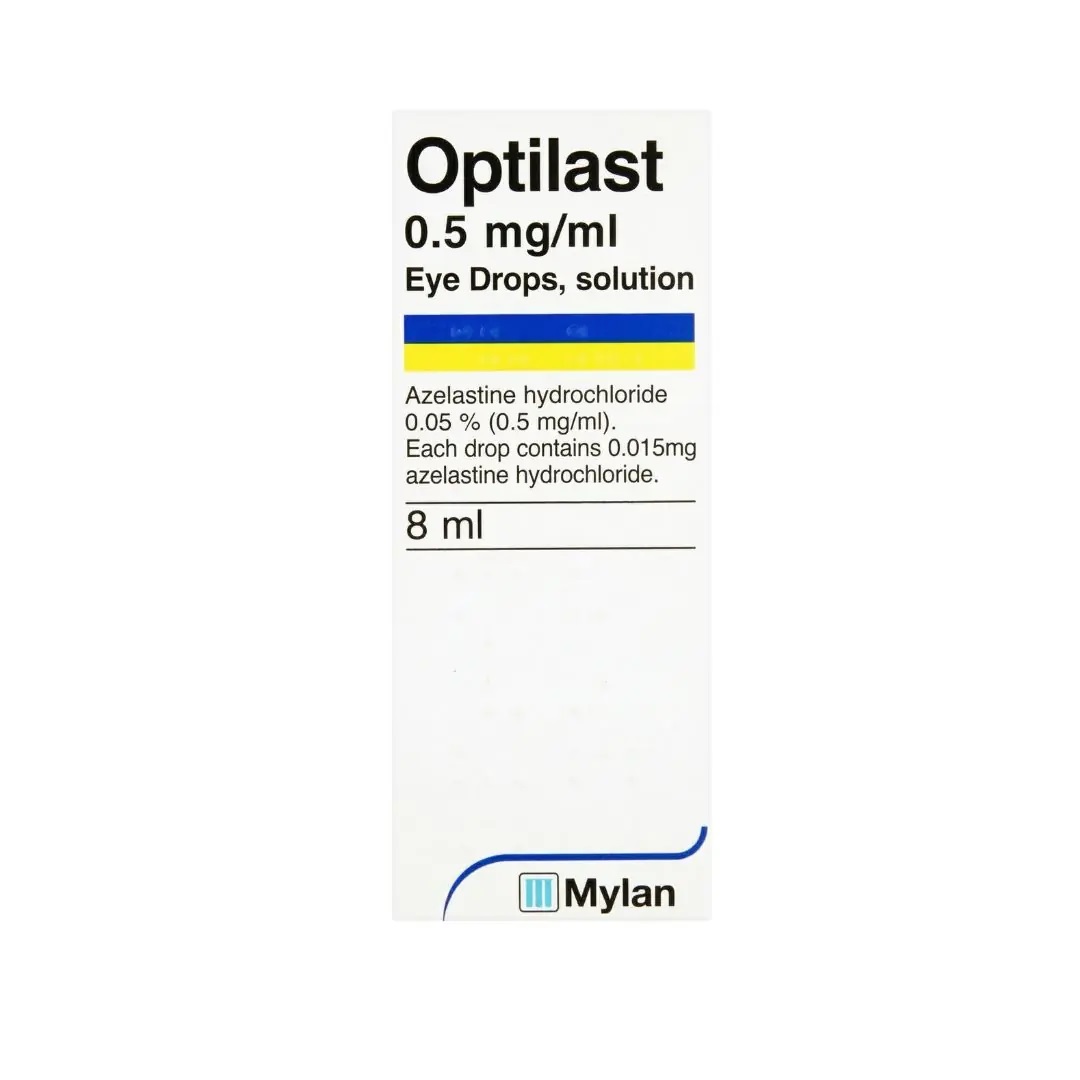
Optilast 0.05% Eye Drops contain azelastine hydrochloride as the active ingredient. Azelastine is an antihistamine that helps reduce the symptoms of allergic conjunctivitis, including itchy, red and watery eyes.
Active Ingredient
Each 1ml of Optilast contains:
- Azelastine hydrochloride 0.5mg
- This is equivalent to a concentration of 0.05%
- Each drop contains approximately 0.015mg of azelastine hydrochloride
Azelastine works by blocking the effects of histamine in the eyes, helping to control the allergic response.
Other Ingredients
Optilast also contains inactive ingredients, known as excipients, which help preserve, stabilise and maintain the eye drop solution.
These include:
- Benzalkonium chloride
- Disodium edetate
- Hypromellose
- Liquid sorbitol, crystallising (E420i)
- Sodium hydroxide (E524)
- Water for injections
Does Optilast Contain Benzalkonium Chloride?
Yes. Optilast contains benzalkonium chloride as a preservative.
The current UK formulation contains 0.125mg of benzalkonium chloride per 1ml of solution.
Benzalkonium chloride can sometimes cause eye irritation, particularly in people with dry eyes or conditions affecting the cornea.
It can also be absorbed by soft contact lenses and may discolour them.
Contact Lenses
If you wear soft contact lenses:
- Remove them before applying Optilast
- Wait at least 15 minutes after using the drops before reinserting them
- Avoid allowing the dropper tip to come into contact with your lenses, eye or surrounding surfaces
Allergy and Sensitivity Information
Do not use Optilast if you are allergic to:
- Azelastine hydrochloride
- Benzalkonium chloride
- Any of the other ingredients contained in the eye drops
If you have known allergies, sensitivities, dry eye problems or a condition affecting the surface of the eye, speak to a healthcare professional before using the drops.
Important Information
Always check the patient information leaflet supplied with your medicine for the most up-to-date ingredient information.
For professional advice about Optilast ingredients, azelastine eye drops, allergic conjunctivitis or hay fever eye treatment, speak to a qualified healthcare professional at Chesterfield Delivery Pharmacy.
Warnings
Optilast contains azelastine hydrochloride, an antihistamine used to treat allergic conjunctivitis. Although suitable for many people with allergy-related eye symptoms, certain conditions require additional care.
Always read the patient information leaflet and speak to your doctor or pharmacist if you are unsure whether Optilast is suitable for you.
Do Not Use Optilast If:
- You are allergic to azelastine hydrochloride
- You are allergic to any of the other ingredients in the eye drops
- You are trying to treat an eye infection, as Optilast is intended for allergic eye symptoms rather than bacterial, viral or fungal eye infections
If you have eye pain, significant discharge, worsening redness or symptoms that suggest an infection, seek professional advice rather than continuing to self-treat with allergy eye drops.
Contact Lenses
Optilast contains benzalkonium chloride, a preservative that can be absorbed by soft contact lenses and may alter their colour.
If you wear contact lenses:
- Remove them before applying Optilast
- Wait at least 15 minutes after using the drops before reinserting them
- Do not apply Optilast while your soft contact lenses are in place
Benzalkonium chloride may also cause irritation, particularly in people with dry eyes or conditions affecting the cornea.
Dry Eyes or Corneal Problems
Speak to a healthcare professional if you have:
- Persistent dry eyes
- A condition affecting the cornea
- Ongoing eye irritation
- Stinging or pain after applying the drops
The preservative in Optilast can affect the tear film and surface of the cornea in susceptible people, particularly during prolonged use.
Blurred Vision and Driving
Your vision may become temporarily blurred after applying Optilast.
If this happens:
- Do not drive
- Do not cycle
- Do not operate machinery
Wait until your eyesight has completely returned to normal before carrying out activities that require clear vision.
Pregnancy
If you are pregnant, think you may be pregnant or are planning a pregnancy, speak to your doctor or pharmacist before using Optilast.
There is limited information about the safety of azelastine during human pregnancy. Although only very small amounts are expected to enter the bloodstream after using the eye drops, current UK prescribing information recommends caution during pregnancy.
Breastfeeding
Azelastine can pass into breast milk in small amounts.
For this reason, current UK prescribing information states that Optilast is not recommended during breastfeeding.
Speak to a healthcare professional about the most appropriate allergy treatment if you are breastfeeding.
Other Medicines
No specific clinically important medicine interactions have been identified with Optilast eye drops, and absorption into the bloodstream after use in the eyes is very low.
However, you should still tell your doctor or pharmacist if you:
- Take prescription medicines
- Use other eye drops
- Take over-the-counter medicines
- Use supplements or herbal remedies
If you use more than one type of eye medicine, ask your pharmacist how long to leave between each product.
When Should I Seek Medical Advice?
Contact a healthcare professional if:
- Your symptoms become worse
- Your symptoms do not improve after 48 hours
- You develop significant eye pain
- Your vision changes or remains blurred
- You develop persistent eye irritation
- You suspect an eye infection
- You experience swelling, rash or another possible allergic reaction
Optilast treatment courses should generally not exceed 6 weeks unless advised otherwise by a healthcare professional.
Important Information
Always use Optilast exactly as directed and do not exceed the recommended dose.
For professional advice about Optilast 0.05% Eye Drops, allergic conjunctivitis, hay fever eye symptoms or antihistamine eye drops, speak to a qualified healthcare professional at Chesterfield Delivery Pharmacy.
Side Effects
What Are the Side Effects of Optilast 0.05% Eye Drops?
Like all medicines, Optilast can cause side effects, although not everyone will experience them. Most reported effects are mild and short-lived.
Common Side Effects
A common side effect, which may affect up to 1 in 10 people, is:
- Mild, temporary irritation in the eye after applying the drops
This may feel like brief stinging, burning or general discomfort and will often settle quickly.
Uncommon Side Effects
An uncommon side effect, which may affect up to 1 in 100 people, is:
- A bitter or unpleasant taste in the mouth
This can occasionally occur after the eye drops have been applied.
Very Rare Side Effects
Very rare allergic reactions may occur, including:
If you experience symptoms that suggest a significant allergic reaction, stop using the medicine and seek medical advice.
Temporary Changes in Vision
Some people may notice temporary blurred vision immediately after applying eye drops.
If your vision is affected:
- Wait until your eyesight is completely clear before driving
- Do not cycle or operate machinery until your vision has returned to normal
When Should I Seek Medical Advice?
Speak to your doctor, pharmacist or other healthcare professional if:
- Eye irritation is severe or persistent
- You develop significant eye pain
- Your vision remains blurred or changes unexpectedly
- Your eyes become increasingly red or uncomfortable
- Your symptoms become worse
- Your allergy symptoms do not improve within 48 hours
Optilast is intended for allergic conjunctivitis and should not be used to treat an eye infection.
Serious Allergic Reactions
Seek urgent medical attention if you develop severe symptoms such as:
- Swelling of the face, lips, tongue or throat
- Difficulty breathing or swallowing
- A widespread or severe allergic reaction
Important Information
Always use Optilast exactly as directed and read the patient information leaflet supplied with your medicine.
Treatment courses should generally be limited to a maximum of 6 weeks unless a healthcare professional advises otherwise.
For professional advice about Optilast side effects, allergic conjunctivitis, hay fever eye symptoms or antihistamine eye drops, speak to a qualified healthcare professional at Chesterfield Delivery Pharmacy.
Storage
How Should I Store Optilast 0.05% Eye Drops?
Optilast should be stored and handled carefully to help keep the eye drop solution clean and suitable for use.
Optilast Storage Instructions
- Keep Optilast out of the sight and reach of children
- No special temperature or refrigeration conditions are required
- Keep the bottle securely closed when it is not being used
- Avoid touching the dropper tip to your eye, fingers or other surfaces
- Do not use the medicine after the expiry date shown on the bottle or outer packaging
The expiry date refers to the last day of the month printed on the pack.
How Long Can Optilast Be Used After Opening?
Once the bottle has been opened for the first time, Optilast should be used for no longer than 4 weeks.
After four weeks, dispose of the bottle even if some solution remains.
It can be useful to write the date you first opened the bottle on the packaging so you know when it should be replaced.
Keeping the Eye Drops Clean
To reduce the risk of contamination:
- Wash your hands before using the drops
- Do not allow the dropper tip to touch your eye, eyelid or fingers
- Replace the cap securely immediately after use
- Do not share your Optilast eye drops with another person
If the solution appears different from normal or you think the bottle may have become contaminated, stop using it and speak to a pharmacist.
How Should I Dispose of Unused Optilast?
Do not dispose of unwanted or expired Optilast through household wastewater.
Take medicines you no longer require to a pharmacy and ask how they should be disposed of safely.
Important Information
Optilast has an unopened shelf life of 3 years, but once opened the bottle must be discarded after 4 weeks. No special storage precautions are required under the current UK product information.
Always read the patient information leaflet supplied with your medicine.
For professional advice about Optilast 0.05% Eye Drops, storage, allergic conjunctivitis or hay fever eye treatment, speak to a qualified healthcare professional at Chesterfield Delivery Pharmacy.











Reviews
There are no reviews yet.